
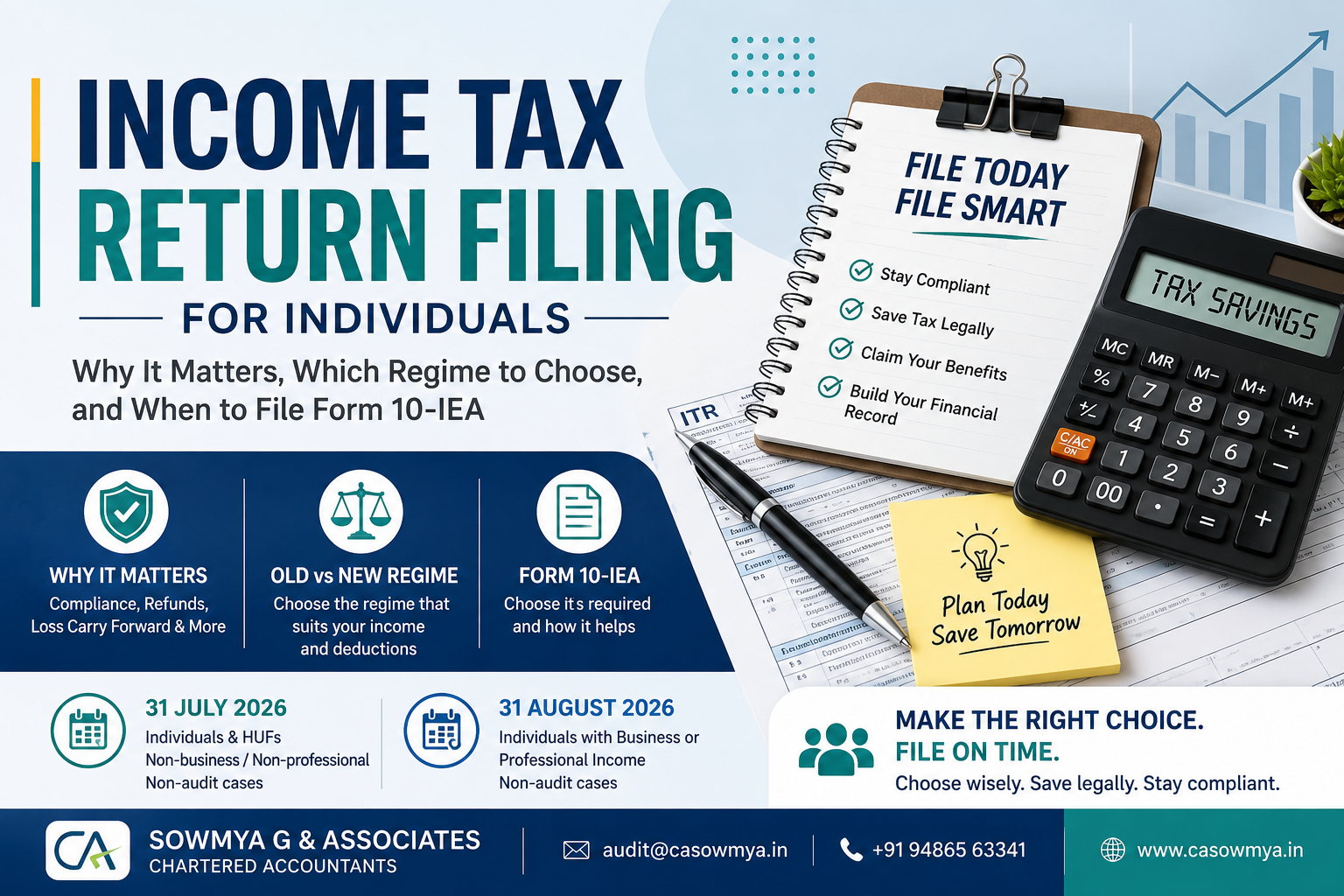
Income Tax Return Filing for Individuals: Why It Matters, Which Regime to Choose, and When to File Form 10-IEA
Filing your Income Tax Return is more than a legal obligation — it is your financial passport. But with two tax regimes now in play, which one should you choose? And if you have business income, do you know when Form 10-IEA needs to be filed? Read on for a complete, plain-language guide.
1. Why Filing Your Income Tax Return Is Not Optional — It Is Smart
Every year, as the ITR filing deadline approaches, many individuals wonder whether they really need to file a return — especially if their tax has already been deducted at source (TDS) by their employer. The answer is an emphatic yes, and here is why.
Filing your Income Tax Return (ITR) is not merely a statutory formality. It is a declaration of your financial integrity, a shield against future notices, and a stepping stone to multiple financial benefits. Let us look at why filing your ITR matters beyond mere compliance.
1.1 Legal Compliance and Avoiding Penalties
Under the Income Tax Act, any individual whose gross total income exceeds the basic exemption limit — currently ₹3,00,000 under the New Tax Regime — is required to file an ITR. Failure to file attracts late filing fees under Section 234F, which can go up to ₹5,000 (₹1,000 for income up to ₹5 lakh). Non-filing can also trigger scrutiny notices from the Income Tax Department.
1.2 Claiming Your Tax Refund
If excess TDS has been deducted from your salary, bank interest, or other income, you can reclaim this only by filing your ITR. Without filing, that money simply stays with the government — money that is rightfully yours.
1.3 Establishing Financial Credibility
ITR acknowledgments are among the most widely accepted proofs of income. Banks, housing finance companies, and visa processing authorities require ITRs — typically for two to three years — as a pre-condition for loan approvals, credit card issuances, and visa applications. Filing consistently builds your financial footprint.
1.4 Carry Forward of Losses
If you have incurred capital losses — whether from equity shares, mutual funds, or property — you can set them off against future gains only if you have filed your ITR on time (i.e., before the due date). This carry-forward benefit, available for up to eight assessment years, can significantly reduce your future tax liability.
1.5 Supporting Nation Building
The taxes collected through ITR filings fund public infrastructure, healthcare, education, and social welfare schemes. Filing your return is, in a real sense, your contribution to the country's development.
1.6 Income Record for Future Reference
An ITR creates an official, time-stamped record of your income, assets, and financial profile. This becomes invaluable during property purchases, business registrations, or any situation requiring proof of financial standing.
Key Takeaway Filing ITR is not just a legal duty — it is a smart step towards a secure financial future. File on time. File accurately. And let your return work for you. |
2. The Two Tax Regimes: Understanding Your Choice
Since Assessment Year 2021-22, individual taxpayers have had the option to choose between two distinct tax regimes: the Old Tax Regime (OTR) and the New Tax Regime (NTR). With effect from Assessment Year 2024-25, the New Tax Regime has been made the default regime. Understanding the difference is critical for tax planning.
2.1 At a Glance: NTR vs OTR
| Parameter | New Tax Regime (NTR) — Default | Old Tax Regime (OTR) |
|---|---|---|
| Tax Rates | Lower flat rates (no surcharge benefit for some) | Higher rates with surcharge benefits |
| Deductions | Most deductions not available (80C, HRA, etc.) | All deductions available (80C, 80D, HRA, LTA, etc.) |
| Exemptions | Standard Deduction ₹75,000 only | All exemptions like HRA, LTA, etc. |
| Home Loan Interest | Loss from house property cannot be set off | Loss from house property setoff allowed |
| Best Suited For | Salaried with few investments / simple returns | Taxpayers with high deductions & investments |
| ITR Form | ITR-1 / ITR-2 (no business income) | ITR-3 / ITR-4 if having business income |
2.2 New Tax Regime — Tax Slabs (AY 2025-26 Onwards)
| Income Slab | Tax Rate (NTR) |
|---|---|
| Up to ₹3,00,000 | Nil |
| ₹3,00,001 – ₹7,00,000 | 5% |
| ₹7,00,001 – ₹10,00,000 | 10% |
| ₹10,00,001 – ₹12,00,000 | 15% |
| ₹12,00,001 – ₹15,00,000 | 20% |
| Above ₹15,00,000 | 30% |
Note: Tax rebate under Section 87A is available for total income up to ₹7,00,000 under NTR and ₹5,00,000 under OTR, making the effective tax liability nil up to those income levels.
2.3 Which Regime Should You Choose?
The answer depends on your specific financial profile. As a thumb rule:
- If your total eligible deductions (80C + 80D + HRA + home loan interest + others) exceed approximately ₹3.75 lakh for income around ₹15 lakh, the Old Tax Regime may be more beneficial.
- If you have fewer investments, no home loan, or wish to avoid the paperwork of claiming deductions, the New Tax Regime with its lower flat rates is simpler and often tax-efficient.
- Always compute your tax under both regimes before making the selection. Your Chartered Accountant can run this comparison for your specific numbers.
Important Rule for Taxpayers with Business/Professional Income Salaried individuals and those without business or professional income can switch between NTR and OTR every year as per their benefit.
However, if you have income from business or profession (and file ITR-3 or ITR-4), the rules are stricter — once you opt out of the New Tax Regime and choose OTR, you cannot switch back to NTR in a subsequent year (except in limited circumstances). This is where Form 10-IEA becomes critical. |
3. Form 10-IEA: The Gateway to the Old Tax Regime for Business Income Taxpayers
3.1 What is Form 10-IEA?
Form 10-IEA is a declaration form filed electronically on the Income Tax Portal. It is required when a taxpayer who has income from business or profession — i.e., one who files ITR-3 or ITR-4 — wishes to opt out of the New Tax Regime and exercise the Old Tax Regime for that assessment year.
In other words, Form 10-IEA is your formal intimation to the Income Tax Department that you are choosing to be taxed under the Old Tax Regime instead of the default New Tax Regime for that particular year.
3.2 Who Needs to File Form 10-IEA?
Form 10-IEA is applicable only to individuals (and HUFs) who:
- Have income from business or profession, AND
- Wish to opt for the Old Tax Regime (OTR) instead of the New Tax Regime (NTR).
Salaried individuals filing ITR-1 or ITR-2 do NOT need to file Form 10-IEA. They can indicate their regime choice directly in the ITR form itself.
3.3 When Must Form 10-IEA Be Filed?
Form 10-IEA must be filed on or before the due date for filing the ITR — generally July 31st for non-audit cases and October 31st for cases liable for tax audit. Late filing of Form 10-IEA may mean your regime choice is not recorded, defaulting you to the New Tax Regime.
3.4 The 10-Case Guide — When Form 10-IEA Is Required
The following table — based on three-year filing patterns — captures all common scenarios and clarifies when Form 10-IEA needs to be filed. This is particularly useful for taxpayers who move between salaried and business income, or who shift between regimes across years.
OTR = Opting Out of Tax Regime (i.e., Old Regime) | NTR = New Tax Regime | ITR-1/2 = No Business Income | ITR-3 = Business/Professional Income
| Case | Year 1 | Year 2 | Year 3 | Form 10-IEA Requirement |
|---|---|---|---|---|
| 1 | ITR-1/2 (OTR/NTR) | ITR-1/2 (OTR/NTR) | ITR-1/2 (OTR/NTR) | Not Required |
| 2 | ITR-1/2 (OTR/NTR) | ITR-3 (NTR) | ITR-3 (OTR) | Required in Year 3 for Opting OTR |
| 3 | ITR-3 (OTR) | ITR-3 (OTR) | ITR-3 (OTR) | Required in Year 1 for Opting OTR. Not required in Year 2 or 3. |
| 4 | ITR-3 (OTR) | ITR-3 (NTR) | ITR-3 (NTR) | Required in Year 1 for Opting OTR. Cannot re-opt OTR unless business income ceases. |
| 5 | ITR-3 (NTR) | ITR-3 (OTR) | ITR-3 (OTR) | Required in Year 2 for Opting OTR |
| 6 | ITR-1/2 (OTR/NTR) | ITR-1/2 (OTR/NTR) | ITR-3 (OTR) | Required in Year 3 for Opting OTR |
| 7 | ITR-1/2 (OTR/NTR) | ITR-1/2 (OTR/NTR) | ITR-3 (NTR) | Not Required |
| 8 | ITR-3 (OTR) | ITR-1/2 (OTR/NTR) | ITR-3 (OTR) | Required in Year 1 for Opting OTR |
| 9 | ITR-3 (NTR) | ITR-1/2 (OTR/NTR) | ITR-3 (OTR) | Required in Year 3 for Opting OTR |
| 10 | ITR-3 (NTR) | ITR-1/2 (OTR/NTR) | ITR-3 (NTR) | Not Required |
Key Insight from the Table Form 10-IEA is triggered specifically in the year when a taxpayer with business income FIRST opts for the Old Tax Regime. If you consistently file ITR-1/2 with no business income, Form 10-IEA is never required — regardless of which regime you choose. Be especially careful in Case 4: once you opt for OTR and then switch back to NTR, you cannot return to OTR unless your business income ceases entirely. |
3.5 The Irreversibility Trap — Case 4 Explained
Case 4 deserves special attention. If a taxpayer opts for OTR in Year 1 (filing ITR-3 with OTR), then moves to NTR in Year 2 or Year 3, they are permanently locked into NTR for subsequent years — as long as they continue to have business or professional income. The only exit from this lock-in is if their business income ceases entirely (and they revert to ITR-1/2).
This makes the initial decision to opt for OTR — and the decision to switch out of it — consequential choices that require careful deliberation and professional guidance.
4. Practical Checklist for Individuals — Before Filing Your ITR
Before you or your CA files your ITR, ensure the following:
- Collect Form 16 from employer (Part A and Part B)
- Download Form 26AS and Annual Information Statement (AIS) from the Income Tax Portal — verify all TDS credits
- Gather interest certificates from banks (savings account, FD interest)
- Compile investment proofs: LIC premium, PPF, ELSS, NPS, school fees, housing loan certificate
- If you have capital gains, download broker statements and mutual fund capital gain statements
- For rental income, keep rent receipts and details of municipal taxes paid
- Decide on your tax regime based on a comparative computation
- If you have business income and wish to opt OTR, ensure Form 10-IEA is filed before the ITR due date
5. Important Deadlines — AY 2025-26 (FY 2024-25)
| Category of Taxpayer | Due Date for ITR Filing |
|---|---|
| Individual / HUF / AOP — No Audit | 31st July 2025 |
| Individual with business income liable to Tax Audit | 31st October 2025 |
| Cases requiring Transfer Pricing Report | 30th November 2025 |
| Belated / Revised Return (non-audit) | 31st December 2025 |
6. Concluding Thoughts
Filing your Income Tax Return on time and choosing the right tax regime are two of the most impactful financial decisions an individual can make every year. These choices determine your tax outgo, your eligibility for deductions, your ability to carry forward losses, and even your access to credit.
Form 10-IEA, while a seemingly technical filing requirement, is the linchpin for taxpayers with business income who wish to retain the flexibility and deduction benefits of the Old Tax Regime. Filing it on time — and making an informed decision about whether to opt for OTR in the first place — can save significant tax.
If you are unsure which regime suits your financial profile, or if you have business income and need help navigating the Form 10-IEA requirements, we at Sowmya G & Associates are happy to assist you with a personalised tax computation and regime analysis.
Get In Touch Sowmya G & Associates — Chartered Accountants Email: audit@casowmya.in Website: www.casowmya.in Phone: +91 94865 63341
FILE ITR TODAY. SECURE YOUR TOMORROW. |
Disclaimer: This blog is intended for general educational and informational purposes only. It does not constitute professional tax advice. Individual tax situations vary — please consult a qualified Chartered Accountant for advice specific to your circumstances.